
Yeah, I should know this by know. And I do. But occasionally I am so caught up in other things that I just can’t remember the different types and keep them straight. Here are two aids for times like those:
First, the following diagram:

Second, the following script gives a more concrete insight into the various joins.
DECLARE @tableX TABLE ( Xkey INT
                      , colA VARCHAR(10)
                      , colB VARCHAR(10)
                      );

DECLARE @tableY TABLE ( Ykey INT
                      , colC VARCHAR(10)
                      , colD VARCHAR(10)
                      );

INSERT INTO @tableX
     VALUES (1, 'Bob',  'in X & Y')
          , (2, 'Ted', 'in X only');

INSERT INTO @tableY
     VALUES (1, 'Carol', 'in X & Y')
          , (3, 'Alice', 'in Y only');

SELECT 'from X' [X]
     , [x].*
  FROM @tableX [x];

SELECT 'from Y' [Y]
     , [y].*
  FROM @tableY [y];

SELECT 'from X:' [X (INNER) JOIN Y]
     , [x].*
     , 'from Y:' [ ]
     , [y].*
  FROM @tableX [x]
       INNER JOIN @tableY [y]
               ON [x].[Xkey] = [y].[Ykey];

SELECT 'from X:' [X LEFT (OUTER) JOIN Y]
     , [x].*
     , 'from Y:' [ ]
     , [y].*
  FROM @tableX [x]
       LEFT OUTER JOIN @tableY [y]
               ON [x].[Xkey] = [y].[Ykey];

SELECT 'from X:' [X RIGHT (OUTER) JOIN Y]
     , [x].*
     , 'from Y:' [ ]
     , [y].*
  FROM @tableX [x]
       RIGHT OUTER JOIN @tableY [y]
               ON [x].[Xkey] = [y].[Ykey];

SELECT 'from X:' [X FULL (OUTER) JOIN Y]
     , [x].*
     , 'from Y:' [ ]
     , [y].*
  FROM @tableX [x]
       FULL OUTER JOIN @tableY [y]
               ON [x].[Xkey] = [y].[Ykey];

SELECT 'from X:' [X CROSS JOIN Y]
     , [x].*
     , 'from Y:' [ ]
     , [y].*
  FROM @tableX [x]
       CROSS JOIN @tableY [y]
 ORDER BY [x].[Xkey], [y].[Ykey];

 SELECT 'came from X:' AS [X UNION Y]
      , [x].[Xkey]     AS [Xkey_U_Ykey]
      , [x].[colA]     AS [colA_U_colC]
      , [x].[colB]     AS [colB_U_colD]
   FROM @tableX [x]
  UNION SELECT 'came from Y:' AS [X UNION Y]
             , [y].[Ykey]     AS [Xkey_U_Ykey]
             , [y].[colC]     AS [colA_U_colC]
             , [y].[colD]     AS [colB_U_colD]
          FROM @tableY [y];
Executing the above script should give these results:
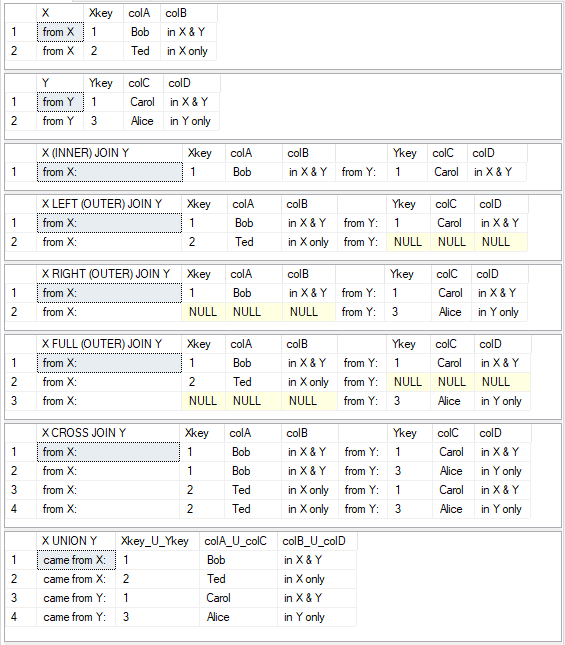
(note: Select keywords in (parentheses) are optional)
And finally, here is a natural language interpretation:
| SELECT FROM | Give me | Special handling |
|---|---|---|
| X | all the rows in X | |
| Y | all the rows in Y | |
| X JOIN Y X INNER JOIN Y | all the rows from X that can be joined with rows in Y, put together as XY rows | – repeats the X portion for each matching Y found. – skips the X row if no rows in Y match the X row. |
| X LEFT JOIN Y X LEFT OUTER JOIN Y | all the rows from X, with rows from Y that can be joined, put together as XY rows | – each X row may join with multiple Y rows. each combination will be a separate XY with the same X. – shows an XY even if no rows in Y were joined to the X row (Y portion is NULLs). |
| X RIGHT JOIN Y X RIGHT OUTER JOIN Y | all the rows from Y, with the rows in X that can join to them, put together as XY rows | – each Y row may be joined to multiple X rows. each combination will be a separate XY with the same Y. – shows an XY even if no rows in X joined to the Y row (X portion is NULLs). – (note: this is equivalent to Y LEFT JOIN X). |
| X FULL JOIN Y X FULL OUTER JOIN Y | all the rows from X, with the rows in Y that can be joined, and all remaining rows in Y, put together as XY rows | – each X row may join with multiple Y rows. each combination will be a separate XY with the same X. – shows an XY even if no rows in Y were joined to the X row (Y portion is NULLs). – shows an XY even if no rows in X joined to the Y row (X portion is NULLs). |
| X CROSS JOIN Y | each row from X joined with each row from Y, put together as XY rows | – repeats each X for each Y. |
| X UNION Y | all the rows from X, plus all the rows from Y, as though they came from the same X table | – column names default to columns from X. – X and Y must have the same column formats. |
 Clive's YABB: lessons learned and promptly forgotten from the wonderful world of programming